
Dock Levelers Explained: The Industrial Feature That Can Save Time, Reduce Damage & Improve Warehouse Efficiency.
When companies evaluate an industrial warehouse or manufacturing facility, they usually compare:
- Location
- Rent
- Built-up area
- Power availability
However, one feature that significantly impacts day-to-day operations is often overlooked:
👉 Dock Levelers
A dock leveler may appear to be a small component of a warehouse, but it plays a crucial role in ensuring smooth loading and unloading operations.
For businesses handling high volumes of goods, investing in a warehouse equipped with dock levelers can lead to faster turnaround times, reduced product damage, improved worker safety, and lower operating costs. Modern industrial facilities increasingly include dock levelers as a standard specification because efficient loading infrastructure has become a competitive advantage.
🚚 WHAT IS A DOCK LEVELER?
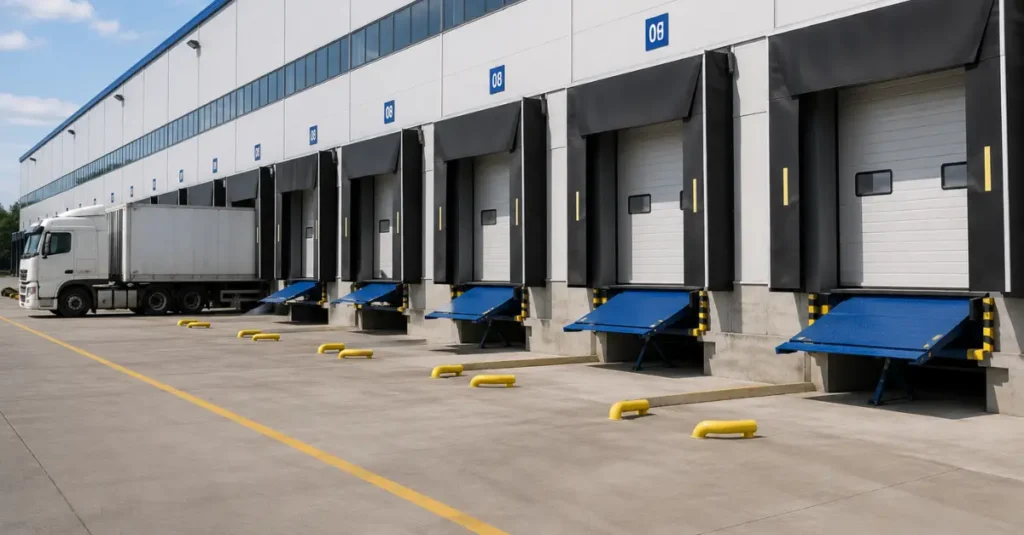
A dock leveler is a movable platform installed between the warehouse floor and a truck or container.
It bridges the height difference between the loading dock and the vehicle, allowing forklifts, pallet trucks, and material handling equipment to move safely and efficiently.
Without a dock leveler, loading operations become slower, less safe, and more labour-intensive.
⭐ WHY MODERN WAREHOUSES USE DOCK LEVELERS
1. Faster Loading & Unloading
A smooth transition between the warehouse and the vehicle enables forklifts to move continuously without interruption.
This results in:
- Faster dispatches
- Reduced truck waiting time
- Improved logistics efficiency
- Higher warehouse productivity
2. Reduced Product Damage
Uneven loading surfaces often cause:
- Pallet instability
- Product breakage
- Equipment vibration
- Accidental drops
Dock levelers provide a level surface that helps protect valuable inventory during loading operations.
3. Improved Worker Safety
Safety is a priority in every industrial facility.
Dock levelers help reduce risks such as:
- Forklift tipping
- Wheel slips
- Manual handling injuries
- Vehicle-to-dock gaps
A safer workplace also contributes to fewer operational disruptions.
4. Better Vehicle Compatibility
Not every truck arrives with the same floor height.
Dock levelers automatically compensate for different vehicle heights, allowing warehouses to handle:
- Light commercial vehicles
- Heavy trucks
- Containers
- Multi-axle trailers
without operational delays.
🏗️ TYPES OF DOCK LEVELERS
Hydraulic Dock Levelers
Ideal for high-volume warehouses.
Advantages
✔ Quick operation
✔ Low manual effort
✔ Long service life
Mechanical Dock Levelers
Suitable for facilities with moderate loading activity.
They offer a cost-effective solution while improving operational efficiency.
Air-Powered Dock Levelers
These use airbag systems for lifting and require minimal maintenance.
They are preferred where energy efficiency is an important consideration.
📦 WHICH INDUSTRIES BENEFIT THE MOST?
Dock-equipped warehouses are particularly valuable for:
- E-commerce fulfilment centres
- Third-party logistics (3PL) companies
- Automotive manufacturers
- FMCG businesses
- Pharmaceutical companies
- Food processing industries
- Engineering manufacturers
These industries rely on quick vehicle turnaround and efficient material movement.
📍 WHY DOCK LEVELERS MATTER IN PUNE’S INDUSTRIAL MARKET
Industrial hubs such as:
- Chakan
- Talegaon
- Ranjangaon
- Bhosari
- Pirangut
are witnessing increasing demand for Grade A warehouses with modern infrastructure.
Many multinational companies now include loading dock specifications in their property selection checklist, making dock-equipped facilities more attractive to premium occupiers.
⚠️ COMMON MISTAKES WHILE SELECTING A WAREHOUSE
Many businesses compare only:
❌ Rent per sq. ft.
❌ Warehouse size
while overlooking operational infrastructure.
Important questions to ask include:
- Does the warehouse have dock levelers?
- How many loading bays are available?
- Is there adequate truck manoeuvring space?
- Can multiple vehicles be loaded simultaneously?
- Is the loading area weather-protected?
These features directly influence operational efficiency.
Two warehouses with identical size and rental cost can deliver very different operational performance.
A warehouse with proper loading docks, dock levelers, wide circulation roads, and efficient truck movement often saves businesses far more in operating costs than the difference in monthly rent.
The right infrastructure improves productivity every single day.
📈 FUTURE TREND: SMART LOGISTICS INFRASTRUCTURE
As supply chains become faster and more technology-driven, warehouses are evolving to include:
✔ Multiple dock levelers
✔ Dock scheduling systems
✔ Automated loading bays
✔ Smart warehouse management systems
✔ High-clear-height storage
Companies choosing future-ready warehouses today are better positioned to meet tomorrow’s logistics demands.
🎯 CONCLUSION
Warehouse selection is no longer just about area and location.
Operational infrastructure—including dock levelers—has become a key factor in warehouse performance.
Businesses that invest in modern industrial facilities benefit from:
✔ Faster logistics operations
✔ Improved worker safety
✔ Reduced product damage
✔ Better vehicle compatibility
✔ Higher operational efficiency
When evaluating your next warehouse, look beyond the square footage. The right loading infrastructure can make a measurable difference to your business performance.
Looking for Modern Warehouses & Industrial Sheds in Pune?
At Authentic Properties, we help businesses identify industrial facilities that are built for efficient operations.
We specialize in:
✔ Grade A Warehouses
✔ Dock-Level Facilities
✔ High Clear-Height Industrial Sheds
✔ Manufacturing Units
✔ Built-to-Suit Industrial Developments
✔ Industrial Land Across Pune’s Major MIDC Zones
📞 Call/WhatsApp: +91 9822148521
🌐 Website: https://authenticproperties.co.in
Authentic Properties – Your Trusted Partner for High-Value Industrial, Commercial, & Hospitality Real Estate.