

Reduce Commercial Property Vacancy in Pune | Landlord Guide.
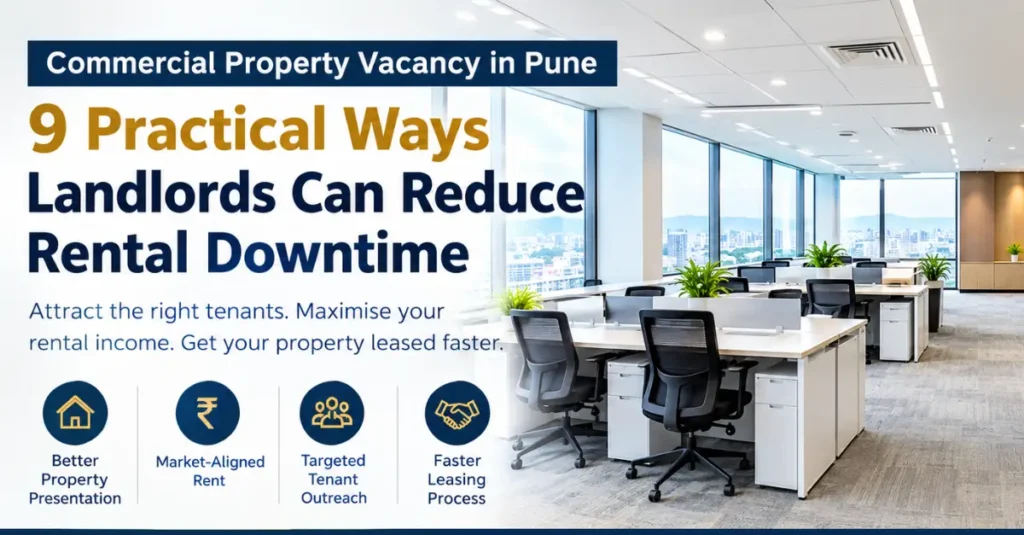
Every Vacant Month Has a Cost
A commercial property can be located in a promising business area and still remain vacant longer than its owner expected.
For property owners, vacancy is not simply the absence of a tenant. It can mean lost rental income, continuing maintenance expenses, security costs and uncertainty about when the next lease will begin.
Some properties remain vacant because their rental expectations do not match the market. Others struggle because the intended tenant profile is unclear, the premises are not ready for occupation, or the property is not reaching the right prospective tenants.
The solution is not necessarily to reduce the rent immediately.
A more effective approach is to identify why the property is not attracting suitable enquiries and address the specific factors affecting its marketability.
For owners looking to lease commercial property in Pune, the following nine strategies can help improve the leasing process, reduce avoidable delays and create better opportunities to secure a suitable tenant.
1. Identify Why the Property Is Remaining Vacant
Before changing the rental price or investing in renovations, understand the reason for the vacancy.
Start by reviewing the property’s recent leasing history and the response received from prospective tenants.
Ask yourself:
Are enquiries being generated but not converting into site visits?
Are prospective tenants visiting but declining to proceed?
Are tenants consistently negotiating for a lower rent?
Is the property suitable for the business activities being targeted?
Are competing properties offering better facilities or commercial terms?
Is the property’s current condition affecting its appeal?
Each pattern suggests a different problem.
For example, limited enquiries may indicate insufficient market exposure or a mismatch between the property and its intended audience. Frequent site visits without serious offers may indicate concerns about pricing, layout, access or infrastructure.
Practical takeaway: Diagnose the problem before spending money on improvements or reducing the asking rent.
2. Set a Rental Expectation That Reflects the Market
Rental expectations are among the most important factors affecting a commercial property’s leasing prospects.
Owners naturally want to achieve the best possible return. However, an asking rent that is significantly above comparable alternatives may discourage qualified tenants from arranging a site visit.
Evaluate comparable properties by considering:
Location and accessibility.
Property type and usable area.
Building quality and maintenance.
Furnishing and existing infrastructure.
Parking availability.
Floor level and visibility, where relevant.
Additional charges payable by the tenant.
Lease conditions and possession readiness.
Avoid comparing properties solely on their advertised rent per square foot. Two properties in the same locality may offer substantially different facilities and usability.
Review recent market feedback and comparable options before deciding whether a rental revision is appropriate.
The objective is to establish a commercially realistic asking rent that supports the owner’s income expectations while remaining competitive with relevant alternatives.
3. Prepare the Property Before Marketing It
First impressions can influence whether a prospective tenant wishes to proceed.
A property that appears poorly maintained, cluttered or incomplete may create doubts about the owner’s maintenance standards and the time required to occupy the premises.
Before arranging inspections, consider:
Cleaning the premises thoroughly.
Repairing visible damage and faulty fittings.
Checking lighting and electrical points.
Ensuring doors, windows and sanitary facilities function properly.
Addressing water leakage or dampness.
Removing unnecessary furniture and stored materials.
Checking air-conditioning and other installed equipment.
Ensuring the property can be accessed for inspections.
For furnished offices, inspect the condition and functionality of workstations, cabins, meeting rooms and existing installations.
For shops and showrooms, pay attention to frontage, visibility, lighting and the overall presentation of the space.
The objective is not to undertake expensive renovation without evidence of need. It is to remove avoidable objections that could prevent an otherwise suitable tenant from considering the property.
4. Identify the Right Tenant Category
A property may struggle to attract tenants when its marketing is too general.
Instead of promoting a space simply as a commercial property for rent, identify the types of businesses for which it may be suitable.
Depending on the property’s permitted use, configuration and facilities, potential tenant categories may include:
Corporate offices and professional firms.
IT and technology companies.
Consulting and service businesses.
Retailers and branded showrooms.
Clinics and other permitted professional establishments.
Training and education businesses, where permitted.
Other businesses whose operational requirements match the premises.
For example, a large furnished office with multiple workstations and meeting rooms may appeal to a company seeking an established office setup. A ground-floor commercial unit with suitable frontage may be more relevant to a showroom or customer-facing business.
These are potential tenant profiles, not guarantees of demand.
Before approaching a particular category, verify that the property’s permitted use, building rules and infrastructure support the intended activity.
A focused tenant strategy helps make property marketing more relevant and reduces time spent on enquiries that are unlikely to convert.
5. Create a Complete and Accurate Property Presentation
Serious tenants need enough information to determine whether a property merits a site visit.
Incomplete advertisements often lead to repeated questions, unsuitable enquiries and unnecessary visits.
Prepare a property information sheet containing:
Exact location and nearby landmarks.
Total area and the applicable area measurement.
Floor and layout details.
Furnishing status.
Workstations, cabins or other existing installations.
Parking availability.
Power supply and backup details, where applicable.
Air-conditioning and internet infrastructure.
Asking rent and deposit expectations.
Applicable maintenance charges.
Possession status and availability.
Permitted usage, subject to verification.
Clear photographs of the actual premises.
Photographs should show the entrance, main space, internal layout, cabins or meeting rooms, washrooms and other relevant features.
If a floor plan is available, include it where appropriate.
Keep the information accurate and update it when the property’s status changes. Do not advertise facilities, approvals or parking arrangements that have not been verified.
A clear presentation enables prospective tenants to assess suitability before committing time to a site visit.
6. Reach Beyond General Property Advertising
Listing a property on a portal can provide visibility, but visibility alone does not guarantee that the right tenant will find it.
Commercial leasing often benefits from reaching businesses whose requirements closely match the available property.
Depending on the asset, potential marketing channels include:
Commercial property portals.
The property consultant’s existing business network.
Direct outreach to relevant companies.
Corporate administration and facilities teams.
Businesses expanding or relocating within the area.
Professional networks and business associations.
Targeted digital marketing.
Referrals from existing clients and industry contacts.
Each channel should serve a clear purpose.
For example, a premium furnished office may benefit from direct outreach to companies seeking immediate occupancy, while a showroom may require outreach to relevant retail brands and business operators.
Maintain a record of enquiries, site visits, feedback and follow-ups. This information can help identify which marketing activities generate serious prospects rather than simply increasing enquiry volume.
7. Make Site Visits Easy to Arrange
A prospective tenant may be interested in a property but lose momentum if arranging a visit becomes difficult.
Commercial tenants often coordinate visits around management availability, operational schedules and multiple competing properties.
To improve the process:
Establish clear inspection timings.
Ensure access arrangements are confirmed in advance.
Keep the property presentable for scheduled visits.
Have the property specifications ready.
Provide accurate directions and relevant access information.
Follow up professionally after the inspection.
Record the prospect’s feedback and next steps.
After a visit, ask what the prospect liked, what concerns remain and whether the property meets the business’s requirements.
Repeated feedback can reveal issues that are not obvious from an owner’s perspective.
For example, several prospects raising the same concern about the layout or rental structure may indicate a need to review the property’s positioning.
Timely, professional communication can help maintain interest while allowing both parties to assess suitability.
8. Review Commercial Terms Without Sacrificing the Property’s Value
Rent is important, but it is not the only factor influencing a tenant’s decision.
The overall commercial proposal may include the security deposit, maintenance charges, furnishing, fit-out permissions, possession timeline, lease tenure and escalation provisions.
If a suitable prospect is hesitant, determine which specific term is creating difficulty.
Possible approaches, where commercially appropriate, may include:
Clarifying the breakdown of recurring charges.
Discussing a mutually acceptable possession date.
Reviewing the security deposit structure.
Considering the existing furnishing or fit-out arrangements.
Evaluating a suitable lease tenure.
Clearly documenting responsibilities for repairs and maintenance.
Any change should be assessed against the owner’s cash flow, risk exposure and long-term rental objectives.
Do not offer concessions automatically. First establish whether the prospect is financially credible, whether the proposed business use is suitable and whether the revised terms improve the likelihood of a sustainable tenancy.
All agreed terms should be documented properly and reviewed by an appropriately qualified legal professional before execution.
9. Work With a Structured Commercial Leasing Process
Managing a commercial property lease involves several stages, from preparing the premises to screening enquiries, arranging inspections and coordinating negotiations.
A structured process helps prevent qualified prospects from being overlooked and makes it easier to identify where delays are occurring.
A practical leasing workflow includes:
Stage 1 — Property preparation: Confirm the premises’ condition, availability, specifications and documentation.
Stage 2 — Market positioning: Establish rental expectations and identify relevant tenant categories.
Stage 3 — Marketing: Publish accurate property details and reach suitable prospective tenants.
Stage 4 — Enquiry screening: Understand the prospect’s business activity, area requirement, budget and expected occupancy date.
Stage 5 — Site visits: Coordinate inspections and collect feedback.
Stage 6 — Commercial discussions: Discuss rent, deposit, tenure and other relevant terms with suitable prospects.
Stage 7 — Verification and agreement: Complete appropriate checks, document the agreed terms and coordinate the transaction.
Stage 8 — Handover: Confirm possession arrangements, responsibilities and the property’s condition at handover.
A commercial property consultant can help owners coordinate these stages, identify suitable prospects and manage communication between the parties.
The owner should remain involved in key decisions, particularly tenant selection and approval of the final commercial terms.
A Simple Commercial Property Vacancy Review
Property owners can use the following checklist to assess whether their current leasing approach needs attention.
☐ Is the asking rent supported by comparable properties?
☐ Is the property clean, functional and ready for inspection?
☐ Are the photographs and property details complete?
☐ Have suitable tenant categories been identified?
☐ Is the property being marketed through relevant channels?
☐ Are enquiries being screened for genuine suitability?
☐ Are site visits easy to arrange?
☐ Is prospect feedback being recorded and reviewed?
☐ Have the commercial terms been evaluated against the owner’s objectives?
☐ Is there a consistent process for follow-up and transaction coordination?
Reviewing these points regularly can help owners identify practical improvements without making unnecessary concessions.
Frequently Asked Questions
1. Why does a commercial property remain vacant for a long time?
Possible reasons include unrealistic rental expectations, limited marketing exposure, poor property presentation, unsuitable layouts, infrastructure limitations or a mismatch between the property and the intended tenant category. The cause should be identified before deciding on corrective action.
2. Should I reduce the rent if my commercial property is vacant?
Not automatically. First compare the property with relevant alternatives, review enquiry and site-visit feedback, and assess the overall commercial terms. A rental revision may be appropriate when market evidence supports it.
3. How can I find suitable tenants for my commercial property in Pune?
Use accurate property information, targeted marketing and relevant business networks. Screen prospects according to their business activity, area requirement, budget, financial suitability and expected occupancy timeline.
4. Does furnishing help a commercial property get leased faster?
Furnishing may appeal to tenants seeking a ready-to-use space, but its value depends on the tenant category, the condition of the installations and the property’s layout. It is not a guarantee of faster leasing.
5. Can a commercial property consultant help reduce vacancy?
A consultant can assist with property positioning, prospective tenant outreach, enquiry screening, site visits and commercial discussions. Results depend on the property’s suitability, market conditions, pricing and tenant demand.
6. What information should I provide when listing a vacant commercial property?
Provide the location, area, floor, permitted use, furnishing status, parking, infrastructure, rent, deposit, recurring charges, possession status and clear photographs. Verify the relevant details before advertising the property.
Conclusion: Treat Vacancy Reduction as a Leasing Strategy
Reducing commercial property vacancy requires more than publishing an advertisement or lowering the asking rent.
Property owners should understand the reason for the vacancy, position the property accurately, maintain the premises, target suitable tenants and establish a consistent process for handling enquiries and site visits.
A thoughtful approach can improve the quality of prospective tenant enquiries and help owners make better-informed leasing decisions.
Every property is different, and no strategy can guarantee immediate occupancy. However, reviewing the property’s market position and leasing process can help owners address avoidable obstacles and work towards more consistent rental income.
Have a Commercial Property to Lease in Pune?
Authentic Properties assists property owners and businesses with high-value commercial, industrial and hospitality property requirements across Pune and PCMC.
If you own a vacant office, showroom or other commercial premises and are looking for a suitable tenant, our team can discuss the property’s specifications, rental expectations and leasing requirements.
Authentic Properties — Your Trusted Partner for High-Value Industrial, Commercial, and Hospitality Properties.
📱 Mobile: 9822148521
☎️ Office: 020-24477221
📧 Email: consult@authenticproperties.co.in
🌐 Website: https://authenticproperties.co.in/
Property owners: Contact us to discuss your commercial property leasing requirement and explore suitable marketing and tenant-matching options.
Please share the property location, area, expected rent, property type, furnishing status and possession availability when enquiring.