

Industrial Property Consolidation: One Large Facility vs Multiple Units.
As an industrial business grows, its property requirements often become increasingly complicated.
A company may initially operate from one small industrial unit. As production increases, additional storage space, assembly areas, offices, parking and dispatch facilities may be added at different locations.
Over time, the business may find itself operating from two, three or even more industrial properties.
At first, this may appear to be a practical solution.
But multiple facilities can create additional costs and operational challenges:
Movement of materials between locations
Multiple rental agreements
Additional security arrangements
Duplicate infrastructure
Higher transportation costs
Management complexity
Difficult inventory coordination
Fragmented workforce
Limited operational visibility
At this stage, an important strategic question arises:
Would it be more efficient to consolidate operations into one larger industrial facility?
The answer depends on the nature of the business, location requirements, capital investment, logistics model and future growth plans.
What Is Industrial Property Consolidation?
Industrial property consolidation means bringing operations that are currently spread across multiple locations into one larger or strategically selected industrial facility.
For example, a company may currently have:
Manufacturing in one location
Raw-material storage in another
Finished-goods storage elsewhere
Administration at a separate premises
Instead of continuing with multiple properties, the company may evaluate a larger industrial facility capable of accommodating several functions under one roof or within one integrated site.
This could be a:
Large industrial shed
Integrated manufacturing facility
Large warehouse
Industrial campus
Industrial plot with existing or proposed development
Built-to-suit facility
The objective is not simply to occupy a larger property.
The objective is to improve the overall efficiency of the business operation.
Why Are Businesses Considering Industrial Consolidation?
There are several reasons why an established industrial business may consider consolidation.
1. Rising Transportation Costs
When raw materials, components, semi-finished goods and finished products move between multiple locations, transportation becomes a recurring operating expense.
A consolidated facility can potentially reduce unnecessary internal movement.
2. Inventory Duplication
Multiple locations may require separate inventory management systems and additional buffer stock.
Consolidation can make inventory visibility easier and potentially reduce unnecessary duplication.
3. Management Complexity
Managing several industrial premises can involve:
Multiple landlords
Multiple maintenance arrangements
Multiple security teams
Different utility connections
Separate compliance requirements
Different operating schedules
A single facility may simplify administration.
4. Better Production Flow
When production stages are distributed across different locations, material movement can slow down the overall process.
A suitably designed larger facility may allow the business to create a more logical production flow.
5. Future Expansion
A company occupying several small units may eventually run out of space at each location.
Moving into a larger facility can create room for future expansion.
One Large Facility vs Multiple Smaller Units
There is no universally correct answer.
The right choice depends on the company’s operational model.
However, comparing the two approaches can help management make a more informed decision.
| Factor | One Large Facility | Multiple Smaller Units |
|---|---|---|
| Administration | Generally simpler | More complex |
| Internal movement | Potentially lower | Potentially higher |
| Security | Centralised | Multiple locations |
| Inventory control | Easier to centralise | More fragmented |
| Expansion | More flexibility if surplus space exists | May require another property |
| Initial rent | May be higher | Can be distributed |
| Location flexibility | Lower | Higher |
| Operational coordination | Easier | More complicated |
| Transportation | Potentially lower | Potentially higher |
| Business continuity | Concentrated risk | Geographic diversification |
The decision should therefore be based on total operating economics, not just rent.
1. Compare the Total Cost—Not Just Rent
One of the biggest mistakes businesses make is comparing:
Rent of one large facility
against
Combined rent of several smaller facilities
without considering the other operating costs.
A proper comparison should include:
Multiple-Facility Cost
Rent + Maintenance + Security + Transportation + Utilities + Management + Duplicate Infrastructure + Inventory Movement
versus:
Consolidated-Facility Cost
Rent + Maintenance + Utilities + Transportation + Facility Management + Infrastructure
The larger facility may have a higher monthly rent but could potentially reduce several other operating expenses.
Therefore, businesses should calculate the total cost of occupancy and operation.
2. Analyse Material Movement
For manufacturing businesses, material movement can be one of the strongest reasons to consider consolidation.
Imagine a production process where:
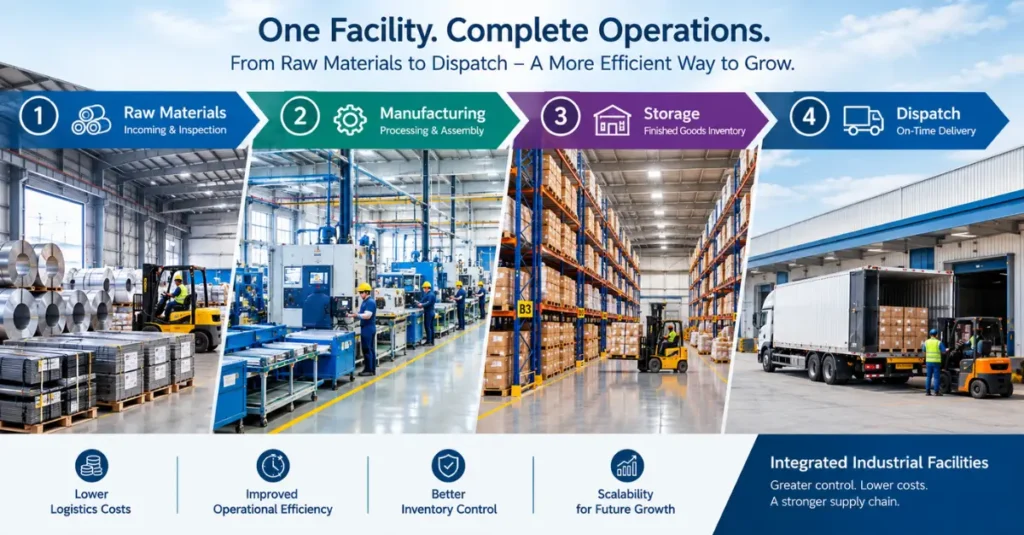
Raw Material → Processing → Assembly → Finished Goods → Dispatch
If these activities are located in different properties, material may need to travel repeatedly between facilities.
This can create:
Additional vehicle trips
Loading and unloading
Handling costs
Waiting time
Damage risk
Inventory tracking challenges
A well-planned large facility can potentially create a smoother internal flow.
However, consolidation only works if the new property is appropriately designed for the business process.
3. Consider Vehicle Movement and Loading Requirements
Large industrial operations need more than just floor area.
Before selecting a consolidated facility, businesses should assess:
Truck entry and exit
Turning radius
Loading bays
Docking requirements
Internal roads
Parking
Trailer movement
Waiting area
Dispatch staging
Fire access
Employee vehicle parking
A large shed with insufficient circulation space may not solve the company’s operational problems.
In some cases, open yard and circulation area can be as important as built-up area.
4. Evaluate the Required Clear Height
Different industrial operations have different vertical-space requirements.
A larger facility may offer opportunities for:
High-level storage
Industrial racking
Cranes
Material handling
Automated storage
Production equipment
But the available clear height should be evaluated against the actual operational requirement.
Businesses should consider:
Existing machinery
Proposed machinery
Crane requirements
Racking height
Storage strategy
Future equipment
Choosing a facility simply because it is large can be a costly mistake if its physical specifications do not match the business.
5. Check Power Infrastructure
For manufacturing companies, electrical infrastructure can determine whether a property is actually usable.
Before consolidating operations, evaluate:
Sanctioned power
Existing electrical infrastructure
Transformer capacity
Generator requirements
Power quality
Future load requirement
Electrical room
Cable routing
Backup power
If the new facility cannot support the required power load, the consolidation strategy may not be commercially viable.
6. Consider Employee Accessibility
Moving into one large facility may improve operational efficiency but could create commuting challenges for employees.
Management should evaluate:
Employee residential locations
Public transport
Bus routes
Employee transportation
Shift timings
Parking
Accessibility from major roads
For a large workforce, employee accessibility can have a direct impact on retention and attendance.
Therefore, location should be evaluated from both a logistics and workforce perspective.
7. Evaluate the Risk of Putting Everything in One Location
Consolidation offers efficiency, but it also creates concentration risk.
If all operations are moved into one facility, an unexpected event affecting that property could potentially disrupt the entire operation.
Businesses should therefore consider:
Fire safety
Flooding or waterlogging risk
Emergency access
Power backup
Security
Insurance
Disaster recovery
Business continuity planning
The objective should be to gain the benefits of consolidation without creating unnecessary operational vulnerability.
8. Think About Future Expansion
One of the biggest advantages of moving into a larger facility can be the availability of expansion space.
A business should ask:
“How much space will we need three, five or ten years from now?”
Consider potential growth in:
Production
Inventory
Employees
Machinery
Packaging
Dispatch
Raw materials
Finished goods
A company that currently requires 40,000 sq. ft. may have substantially different requirements several years later.
A larger facility with suitable expansion potential can therefore provide greater operational flexibility.
9. Consolidation Can Improve Management Control
Managing multiple industrial facilities requires coordination across locations.
A consolidated facility can potentially simplify:
Security
Administration
Maintenance
Inventory supervision
Quality control
Production monitoring
Employee management
Facility management
For growing companies, this can be particularly valuable because management attention can be redirected from property coordination toward the core business.
10. But One Large Facility Is Not Always the Best Solution
Industrial consolidation has clear advantages, but there are situations where multiple facilities may make more sense.
For example:
Different Customer Markets
A distribution company may need warehouses in different geographic markets to serve customers quickly.
Supply Chain Requirements
A business may intentionally maintain storage close to suppliers or customers.
Risk Diversification
Some businesses prefer geographically distributed operations to reduce concentration risk.
Land Availability
A suitably sized industrial facility may not be available in the desired location.
Capital Considerations
Moving into a large facility may involve substantial relocation, fit-out and infrastructure costs.
Therefore, consolidation should be a strategic business decision, not simply a property decision.
A Practical Industrial Consolidation Assessment
Before moving from multiple properties into one large facility, management should compare the following:
Current Situation
Number of facilities
Total built-up area
Total rent
Security deposits
Transportation cost
Maintenance
Utility expenses
Workforce
Inventory movement
Contractual commitments
Proposed Facility
Built-up area
Open area
Rent or purchase price
Deposit
Power
Clear height
Crane capacity
Loading facilities
Parking
Access
Expansion potential
Lease tenure
Fit-out requirement
Then calculate the estimated five-year total cost of both options.
This can provide a much clearer picture than comparing monthly rent alone.
When Should a Business Seriously Consider Consolidation?
Industrial consolidation may deserve serious consideration when:
Multiple facilities are operating within the same region
Material moves frequently between locations
Transportation costs are increasing
Inventory is fragmented
Management finds multi-location operations difficult
Existing premises are reaching capacity
The business expects significant growth
Duplicate infrastructure is increasing operating costs
A suitably large facility becomes available
Existing leases are approaching renewal
These can be signs that the company’s property strategy needs to be reviewed.
Finding the Right Large Industrial Facility
Once a business decides to explore consolidation, the search should be based on operational specifications rather than area alone.
For example, a requirement could look like:
Required Area: 50,000–100,000+ sq. ft.
Location: Chakan / Bhosari / Talegaon / PCMC / Pune region
Clear Height: As required
Power: Based on machinery load
Crane: As required
Open Yard: Required
Truck Access: Heavy-vehicle suitable
Use: Manufacturing / Warehousing / Distribution
Lease: Long-term
Possession: Defined business timeline
This type of clearly defined requirement helps identify properties that are genuinely suitable.
How Authentic Properties Can Help
Finding a large industrial property is often more complex than searching for a standard commercial premises.
The property needs to match the company’s:
Area + Location + Infrastructure + Access + Power + Operations + Budget + Future Growth
At Authentic Properties, we specialise in high-value Industrial, Commercial and Hospitality Properties and assist businesses looking for suitable industrial real estate solutions in Pune and surrounding industrial locations.
Our industrial property requirements include:
Large industrial sheds
Manufacturing facilities
Warehouses
Industrial plots
Large-format industrial properties
Long-term industrial leases
Built-to-Suit requirements
Industrial investment opportunities
If your business is currently operating from multiple industrial premises and you are considering consolidation, sharing your complete requirement can help identify suitable large-format options.
Looking for One Large Industrial Facility in Pune?
If you are evaluating whether to consolidate your operations into a larger industrial property, start with a detailed requirement rather than simply searching by square footage.
Share:
Current Locations | Total Area | Required Area | Business Activity | Power Requirement | Crane Requirement | Open Yard | Budget | Preferred Location | Lease/Purchase Preference
A property consultant can then help identify and compare suitable options based on your operational requirements.
Authentic Properties
Your Trusted Partner for High-Value Industrial, Commercial, and Hospitality Properties
📱 9822148521
☎️ 020-24477221
📧 consult@authenticproperties.co.in
🌐 authenticproperties.co.in
Frequently Asked Questions
Is one large industrial facility always better than multiple smaller units?
No. The right solution depends on the company’s logistics, workforce, supply chain, location requirements, risk strategy and future growth plans.
What are the main advantages of industrial property consolidation?
Potential benefits include reduced material movement, simpler management, better inventory visibility, centralised infrastructure, improved production flow and greater expansion flexibility.
Can consolidation reduce industrial operating costs?
It can, but it depends on the specific circumstances. Businesses should compare total occupancy and operating costs—including transportation, utilities, security, maintenance and inventory movement—not just rent.
What size industrial facility should a growing company choose?
The requirement depends on current operations and expected future growth. Companies should consider production, storage, machinery, parking, loading, workforce and expansion requirements before deciding.
Is a large industrial shed suitable for both manufacturing and warehousing?
Potentially, provided the facility’s specifications, approvals, access, power, loading arrangements, structural characteristics and other requirements are suitable for the intended use.
Where can I find large industrial properties in Pune?
Industrial locations such as Chakan, Bhosari, Talegaon and other Pune-region industrial corridors offer a range of industrial property options. Availability and suitability vary according to the specific requirement.
Conclusion
The decision between one large industrial facility and multiple smaller units should never be based on rent alone.
For some businesses, consolidation can create significant advantages through better material flow, simpler management, improved inventory control and greater expansion potential.
For others, maintaining multiple strategically located facilities may provide better logistics, market access or risk diversification.
The right decision comes from comparing the complete operational and financial picture.
Before making a move, ask:
“Will consolidating our industrial operations make the business more efficient, more scalable and more cost-effective over the next five to ten years?”
If the answer is yes, it may be time to explore a suitably sized industrial facility that can support the company’s next stage of growth.
Looking for a large industrial shed, warehouse or manufacturing facility in Pune? Contact Authentic Properties to discuss your requirement.